


How Soviet flight schools shaped the men who flew Hanoi’s first supersonic interceptors
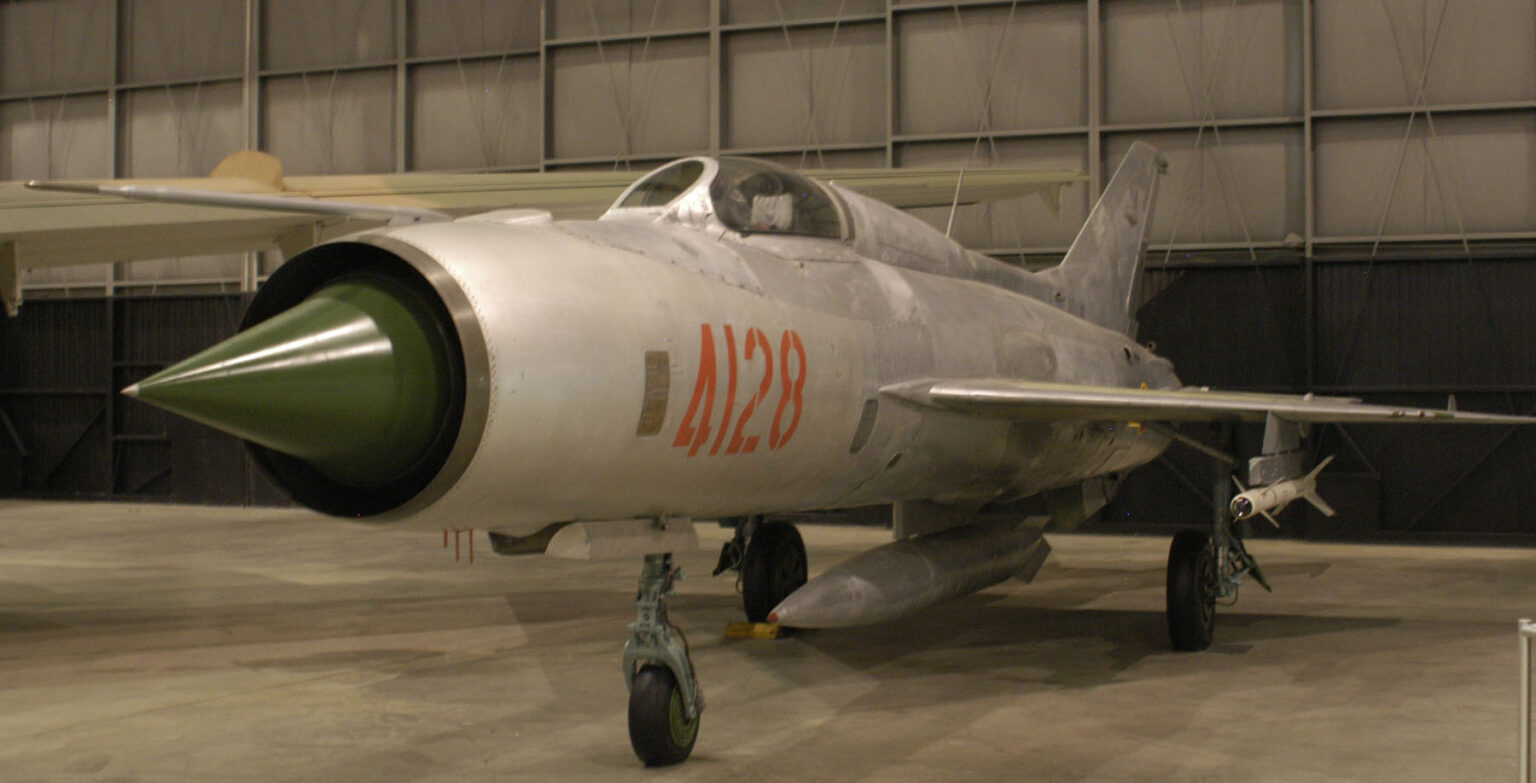
NATO called the Soviet MiG-21 supersonic interceptor the “Fishbed.” Vietnamese pilots called it the “Balalaika,” after the stringed instrument it resembled. The first examples reached North Vietnam in late 1965 as part of a Soviet aid package, arriving at Haiphong in pieces and being moved under cover of darkness to Noi Bai airbase. A second shipment followed through January 1967, bringing the total to 34 fighters and four trainers.
Pilot training had begun well before the aircraft arrived. From the early 1960s, North Vietnamese cadets were sent to the Krasnodar Flight Officers’ School in the Soviet Union, where a year of Russian-language study preceded roughly twenty theoretical subjects covering aerodynamics, weapons, navigation, and tactics. Flight instruction started on the Yak-18, moved to the two-seat MiG-15UTI, and culminated in the MiG-17, with gunnery practice, ejection-seat simulation, and parachute jumps built into the syllabus. From 1966, the Yak-18 was replaced by the L-29 Delfin, after which students added further hours on the MiG-15UTI and MiG-17.
Ace Nguyen Van Coc, an early graduate, recalled that of an original intake of 120, only 23 qualified as pilots. Those who returned to Vietnam in 1964 were posted to the 921st Fighter Regiment, and a year later were chosen for the first MiG-21 conversion course, accumulating 400–500 flying hours before combat (later reduced to 250–300). Pilot Vu Ngoc Dinh described the Soviet instructors as demanding but fair, noting they “never made concessions” and pushed cadets to think independently, in contrast to more lenient Chinese instructors.
A second, larger course began in 1965, pairing pilot trainees with hundreds of engineers sent for technical instruction. Wartime urgency cut the language-preparation period to three months, and only the strongest cadets advanced to the MiG-21 after the L-29 phase. Future ace Nguyen Van Nghia was among 24 pilots chosen to attempt a direct jump from the L-29 to the MiG-21, bypassing the MiG-17; 21 succeeded, and he returned home with 256 logged flying hours. Before departing, experienced pilots briefed the group on aerial combat, though detailed intelligence on American aircraft was limited.
Meanwhile, Vietnamese and Soviet engineers worked through 1965 to prepare Noi Bai for the MiG-21’s arrival, often at night to avoid American bombing. Assembly speed rose from one aircraft per week to one every two to three nights. Soviet pilots test-flew each jet before North Vietnamese units took over. Experienced MiG-17 pilots, including Tran Hanh and Pham Ngoc Lan, converted to the MiG-21 in 1966 and became unit commanders. To build confidence in the new type, commanders staged practice engagements between MiG-21s and MiG-17s, and early rules of engagement restricted MiG-21 pilots to fighter-bombers and drones, keeping them clear of F-4 Phantoms and F-8 Crusaders.
Training continued through the war. A 1967–68 course added night flying and concluded with live missile firing; by mid-1968, four graduates had already returned to combat while 29 others continued training. By then, 97 pilots had completed Soviet or Vietnamese schooling, and between 1965 and 1969, a total of 250 cadets had trained across Soviet, Chinese and Vietnamese academies, alongside 248 additional technical and support personnel.
From 1971, the 921st Fighter Regiment converted to the upgraded MiG-21MF, and new courses converted MiG-17 pilots to the type as the newly formed 927th Fighter Regiment stood up. Nguyen Van Nghia recalled that a relative lull in American bombing of Military District No. 4 allowed pilots to fly five or six days a week, giving Vietnamese aviators combat-relevant experience he considered more valuable than the peacetime training of their American counterparts. In mid-1972, a dozen pilots underwent specialized training to intercept B-52 bombers in poor weather and at night, qualifying by year’s end to engage targets at 10,000 meters. When the United States launched Operation Linebacker in May 1972, veterans of the original 1965 MiG-21 training class led the North Vietnamese air regiments through the war’s heaviest aerial battles, at high cost in both pilots and aircraft.
This article is from the book “MiG-21 Aces of the Vietnam War” by István Toperczer, available here.
