

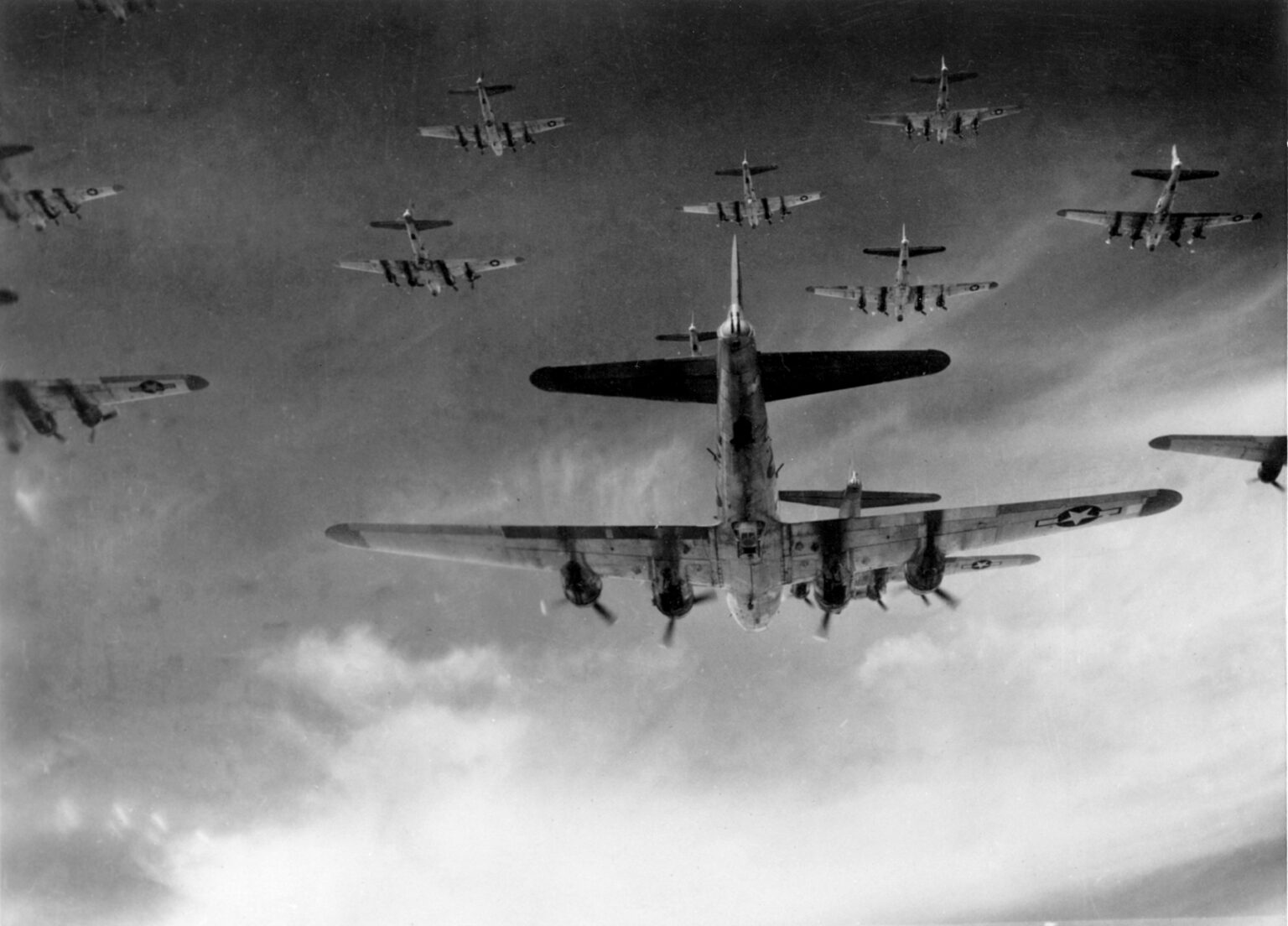

From a troubled debut over the English Channel to the epic double strike on Schweinfurt and Regensburg, the story of one of the Eighth Air Force’s most battle-hardened units
Forming Up: Spring 1943
The 4th Bombardment Wing (BW) was established in May 1943, when the 94th, 95th, and 96th Bomb Groups (BGs) transferred from Northamptonshire southward to bases in Suffolk and Essex. Brigadier General Fred L. Anderson commanded the new organization from Marks Hall, near Colchester.
The Wing’s first mission, on 13 May, targeted the St. Omer-Longuenesse airfield with 72 B-17s. It was an inauspicious debut: the 96th BG lost a Fortress in the Wash shortly after takeoff and failed to bomb the target, while a 14-plane detachment from the 351st BG abandoned the mission mid-Channel.
The following day proved more consequential. Simultaneous attacks struck Wevelghem airfield in Belgium and the Ford and General Motors plant at Antwerp. Wevelghem was so severely damaged that its resident Jagdwaffe unit, III./JG 26, was forced to relocate to Lille-Nord. At Antwerp, German fighters and flak inflicted heavy losses, including a 95th BG bomber whose entire ten-man crew perished when their aircraft crashed on the Dutch island of North Beveland. The day’s combined operations cost the AAF 12 aircraft, though bomber crews and escort fighters claimed 67 German aircraft destroyed.
Through the remainder of May and into June, the Wing participated in repeated raids on northern German ports—Emden, Wilhelmshaven, Kiel, Flensburg, and Heligoland—as well as U-boat pens at St. Nazaire. Losses varied, with the Kiel mission on 15 May proving particularly costly: six Fortresses were downed, three torn apart by bombs dropped from Fw 190s flying above them.
The Kiel Disaster and a Change of Bases
On 13 June, the 94th, 95th, and 96th BGs flew their final missions from their original Suffolk and Essex bases. The raid on Kiel’s U-boat yards turned into a catastrophe. German fighters concentrated almost entirely on the 4th BW, largely ignoring the 1st BW. The 95th BG, led by Brigadier General Nathan Bedford Forrest III—grandson of the famous Confederate cavalry commander—was flying an experimental “flat” formation intended to concentrate firepower more effectively. The tactic proved fatal. A frontal diving attack raked the lead aircraft; guns lubricated with a new oil recommended by Forrest had frozen and could not return fire. The command aircraft went down, and of the 13 men aboard, only one survived; the remaining twelve were carried to their deaths in the Baltic Sea by an offshore wind. Forrest became the first American general to be lost in combat in Europe.
Altogether, the 4th BW lost 22 B-17s that day. Upon returning, the groups landed at new bases—Bury St Edmunds, Horham, and Snetterton Heath—vacating their former fields for incoming B-26 Marauder units.
The Wing’s new commanding officer, Colonel Curtis E. LeMay, arrived at Elveden Hall. Pilot Captain Franklin “Pappy” Colby of the 94th BG recalled his first impression: “He gave us the usual welcome talk and left the impression of being a bit hard-nosed about things, but he had flown a lot of rough ones and had a good record. And he was trying to improve the poor formation flying, which had been so troublesome.”
Deep Penetrations into Germany
Strengthened by the addition of the 100th, 385th, 388th, and 390th BGs, the 4th BW grew to six groups by early July. On 22 June, before this expansion was complete, VIII Bomber Command dispatched 182 bombers on the first deep penetration raid into Germany, targeting a chemical and synthetic rubber plant at Hüls, near Recklinghausen, responsible for roughly 29 percent of Germany’s synthetic rubber output and considered the most heavily defended target in the Reich. Colby, piloting Thundermug, described the mission: “We got the works. They hit us at the Dutch coast, and it got progressively worse… We made a beautiful 55-second run and dropped our pattern square on the buildings alongside a burning tank, which had exploded… It was a rough mission, and we were beginning to wonder about the invincibility of the Flying Fortress.” Sixteen bombers failed to return.
Further raids on Hamburg, Le Mans, St. Nazaire, and Le Bourget followed through June and July, with losses mounting steadily. During the week-long “Blitz Week” beginning 24 July, sustained operations against targets across northern Germany cost the AAF roughly 100 aircraft and 900 men in seven days.
Schweinfurt and Regensburg: The Double Strike
The most significant—and costliest—mission took place on 17 August 1943, the first anniversary of the Eighth Air Force’s inaugural bombing raid in the European Theater. Planners conceived a simultaneous two-pronged attack: the 1st BW would strike ball-bearing plants at Schweinfurt. At the same time, LeMay led the 4th BW to the Messerschmitt factory at Regensburg, which produced an estimated 200 Bf 109s per month—around 25–30 percent of Germany’s single-engine fighter output. To reduce return losses, LeMay’s force would continue south to North Africa rather than flying back through German defenses.
The operation went badly from the outset. A 3.5-hour delay to the 1st BW due to inland fog meant the 4th BW faced the full concentration of German fighter defenses alone. Only one of four assigned P-47 escort groups made the rendezvous, leaving the rear of the 15-mile-long formation unprotected. Seventeen Fortresses were shot down before the bomb run, with even Bf 110 nightfighters deployed against stragglers. The 100th BG alone lost nine aircraft.
Despite the losses, bombing accuracy was high. Six major workshops were severely damaged, a hangar partially destroyed, and some 37 Bf 109s on the ground were damaged or destroyed. Production halted entirely — and, though unknown at the time, the attack had also destroyed fuselage jigs for the still-secret Me 262 jet fighter.
The surviving 128 bombers, many badly damaged, flew on to North Africa. Across both missions that day, 60 B-17s were missing, and a further 60 had to be left in Africa for repair—147 aircraft were lost to all causes on a single day, nearly three times the previous record. German losses stood at just 27 fighters, against claims of 288 by American gunners and escorts.
General Anderson concluded with a message to Wing HQ: “Congratulations on the completion of an epoch in aerial warfare. I am sure the 4th BW has continued to make history. The Hun now has no place to hide.”
This article is from the book “B-17 Flying Fortress Units of the 8th Air Force (part 2)” by Martin Bowman, available here.
