


Born from a troubled development and a hostile press, the swing-wing “Aardvark” went on to become one of the most versatile combat aircraft ever built
The first operational General Dynamics F-111As entered US Air Force (USAF) service in July 1967, after a difficult development. At the insistence of US Secretary of Defense Robert McNamara, similar versions of the design were produced as a US Navy fleet defense fighter (the F-111B, cancelled during development), a Strategic Air Command bomber (the FB-111A), and a tactical fighter-bomber to replace the Republic F-105 Thunderchief. The fighter-bomber was the most numerous version and appeared in four sub-variants. One of them remained in service with the Royal Australian Air Force (RAAF) until December 2010.
Innovation by design
The F-111’s designers introduced many innovative features for an aircraft meant to fulfill such diverse roles with both the USAF and the US Navy:
- Variable-sweep wing: The wing allowed slow-speed flight for carrier landings and supersonic, low-altitude operations when swept back. The F-111 could effectively “redesign itself in flight”.
- Terrain-following radar (TFR): This automatic system lets the aircraft fly at a continuous altitude as low as 200 ft over uneven terrain, at night and in poor weather. These conditions became the aircraft’s natural habitat.
- Afterburning turbofans: The F-111 pioneered their use, which gave better fuel economy than turbojets on long-range attack missions.
- Integrated electronic countermeasures: It was the first tactical fighter to carry an integrated suite for self-protection.
- Escape capsule: At the US Navy’s request, the aircraft had a two-man, side-by-side capsule. It floated after an over-water ejection and spared crews the cumbersome anti-exposure suits required with conventional ejection seats. It also offered much better protection during ejection.
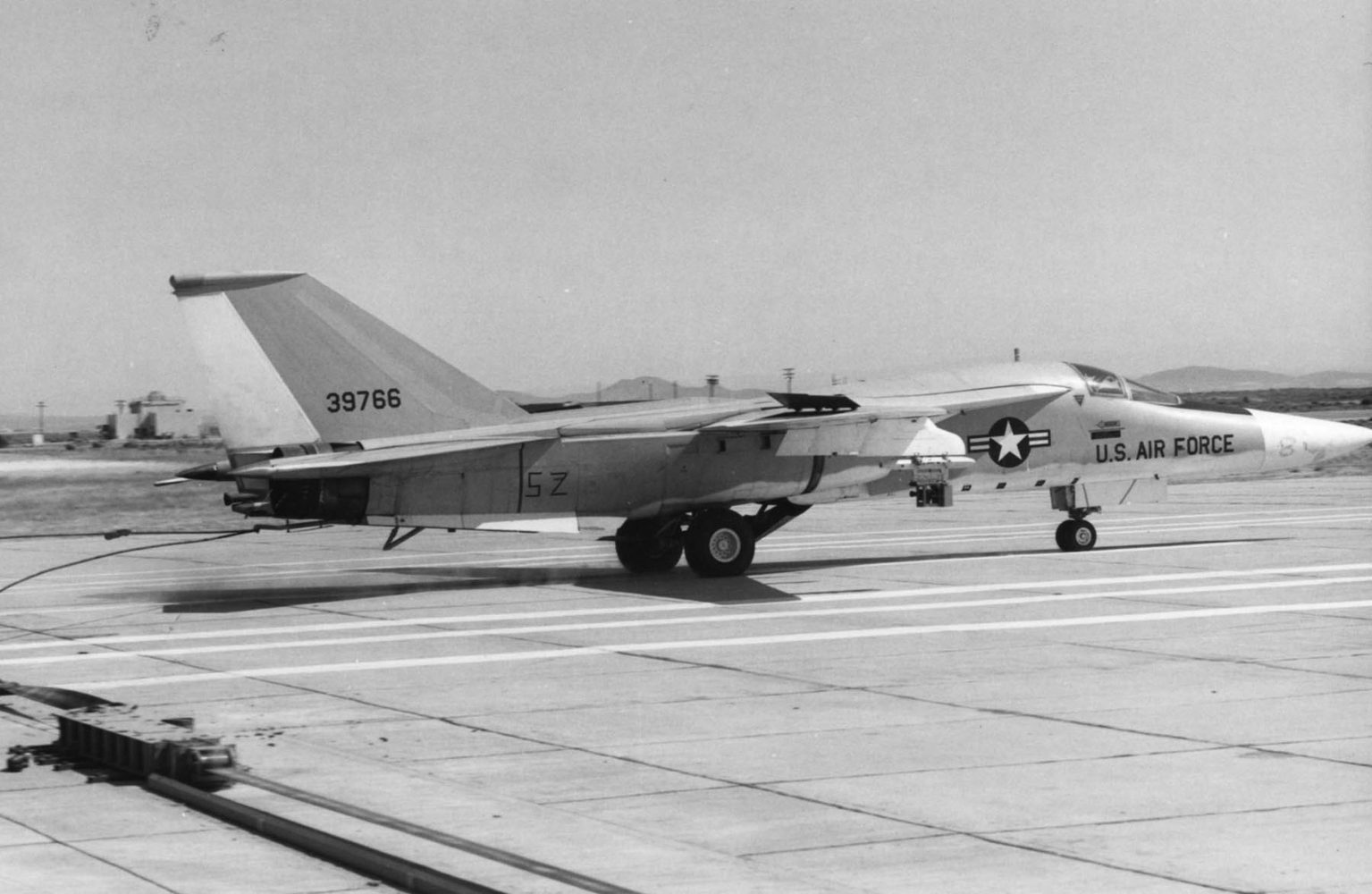
The first F-111A, 63-9766, demonstrated its wing sweep on rollout at General Dynamics’ Fort Worth facility on 16 October 1964. Externally, it looked very similar to the last F-111, delivered in November 1976. After its maiden flight, with General Dynamics test pilots Richard Johnson and Val Prahl in charge, it flew a further 209 times and reached Mach 2.3 in August 1965. Retired in February 1968, it was put on display at the Air Force Flight Test Center Museum at Edwards AFB, California.
Teething troubles and a bad press
With so much untried technology, development problems were inevitable. Air intakes and engines had to be progressively redesigned to cure engine stalls, several wing pivot boxes failed, and the TFR took time to win the confidence of pilots used to flying the aircraft themselves rather than trusting a computer. Some early problems stemmed from errors by component suppliers. The difficulties were overcome fairly quickly, and the F-111’s loss rate during development was very low compared with the early Century Series fighters.
Widespread USAF and US Navy hostility towards a common design that inevitably failed to meet each service’s full requirements magnified these problems publicly. The media then exaggerated them into a long-lasting “trashing” campaign. It took many years for the F-111 to be recognized as one of the most versatile and effective aircraft ever produced.
The aircraft’s reputation was damaged further when it was sent into combat in Vietnam only eight months after its initial delivery, before its USAF acceptance trials were complete. Eight F-111As deployed to Takhli Royal Thai Air Force Base (RTAFB), Thailand, in March 1968, and three were lost in unexplained circumstances after only 55 combat missions. Rather than proving the aircraft to its critics, the episode generated more hostility and threatened the whole program.
Resistance in the cockpit
Part of the resistance came from the crews. The two-man concept was anathema to many former single-seat pilots. Col Bob Pahl, who flew F-111s for 17 years, recalled:
‘Former F-105 pilots, many with 100 missions over North Vietnam, didn’t like to fly with WSOs [Weapons System Officers], and they would ignore the guy in the right seat as much as possible. Initially, there was a lot of resentment in both the navigator/WSO and pilot communities. They ran out of WSOs, so they put PWSOs [pilot/WSOs] in the right seat.’
Some aircrew even applied to leave the USAF rather than move from single-seaters to the F-111. Attitudes changed as younger aircrew joined the service, and the proportion of senior officers in squadrons declined.
Learning to trust the TFR
F-111 crews soon realized that the auto-TFR worked well, although it required careful monitoring. They had to get used to night descents in mountainous terrain. An initial ten-degree dive was increased automatically when the TFR picked up ground returns, and the aircraft continued to dive at more than 500 knots until it levelled off automatically at around 1,600 ft.
Sometimes it was best to trust the TFR rather than human judgment. Lt Col Ed Wells recalled a fatal accident at Indian Springs, near Nellis AFB, in October 1975. F-111A 66-0058, with Capt David Bowles and Maj Don Kenney aboard, hit the side of a hill after a major engine malfunction:
‘The crew were making a night bombing run, and they were on final approach at 200 ft on auto-TFR when they heard a thump, both fire warning lights came on, and then the stick froze. The instructor pilot made a bad decision when he “paddled off” [de-selected] the auto-TFR while he assessed the problem.’
The aircraft struck a 200 ft high mesa (an elevated flat-topped landform with steep sides) some 30 ft from its top. The investigation included a search for evidence. ‘George Peacock, Operations Officer for the 428th TFS [Tactical Fighter Squadron], took his entire squadron out on the desert a couple of miles back from the mesa’, noted Wells. ‘During their long walk across the desert in line abreast, one of his pilots picked up a fan blade from the first stage of a TF30. It weighed only a pound and was just a foot long. Accident solved again, and “Vark” grounded again for quite some time’. It was the third Nellis loss caused by cracked fan blades.
The 452nd CCTS at Nellis AFB trained F-111A crews from January 1968 until the squadron was renumbered the 442nd TFTS in October 1969, and it continued the training role until August 1977. One of its aircraft, still in standard Southeast Asian camouflage with FS 36622 Light Gray undersides, was lost at Peach Springs, Arizona, on 6 June 1975. The circumstances were very similar to those of 66-0058, this time following a turbine blade failure, and Capt. David Bowles was again the pilot.
Familiar avionics and a digital leap
Other aspects of the F-111 were familiar to crews transitioning from other types. Col. Bob Brotzman, former commander of the 391st TFS, which flew A-model jets, recalled:
‘The Mk 1 avionics in the F-111A and F-111E were basically quite similar to the avionics in the F-4 Phantom II—analogue ballistics and navigation computers with lots of rats busily whirring their respective treadmills. The inertial navigation platform was much more accurate, and the attack radar was far superior for ground mapping and target acquisition. The TFR gave the aircraft something the Phantom II never had, but the basic “guts” of the avionics were not much advanced from the F-4 in terms of automating the in-flight experience.’
Real improvements came with the F-111D’s digital avionics, which crews described as a “truly staggering advance” in capability. Nothing matched it until the F-15E Strike Eagle became operational in the early 1990s. Its Doppler radar was “amazingly accurate” for navigation. The F-111D took several years to become fully serviceable. Elements of its Mk II avionics were later incorporated into the F-111F and into upgrades to the F-111E and the RAAF F-111C.
These advances were still in early development when the F-111A first went to war, flown by the first crews trained on the type at Nellis AFB. F-111A 66-0018 was the jet of Combat Lancer (Det 1) commander Col. Ike Dethman, and it led the deployment to Takhli RTAFB on 15 March 1968. It also led the detachment’s first combat mission ten days later. The aircraft is pictured loaded with M117 demolition bombs and carrying an AN/ALQ-87 ECM pod below the wing glove sweep mechanism. An EB-66 of the 42nd TEWS parked behind it provided barrier jamming of enemy radars for the base’s 355th TFW F-105 Thunderchiefs, which was unnecessary for F-111A operations. The aircraft was later converted to EF-111A specification in 1983 and flew with the 366th TFW and 27th FW. It was retired to AMARC in June 1998 after a belly landing.
This article is from the book “F-111 & EF-111 Units in Combat” by Peter E. Davies, available here.
