

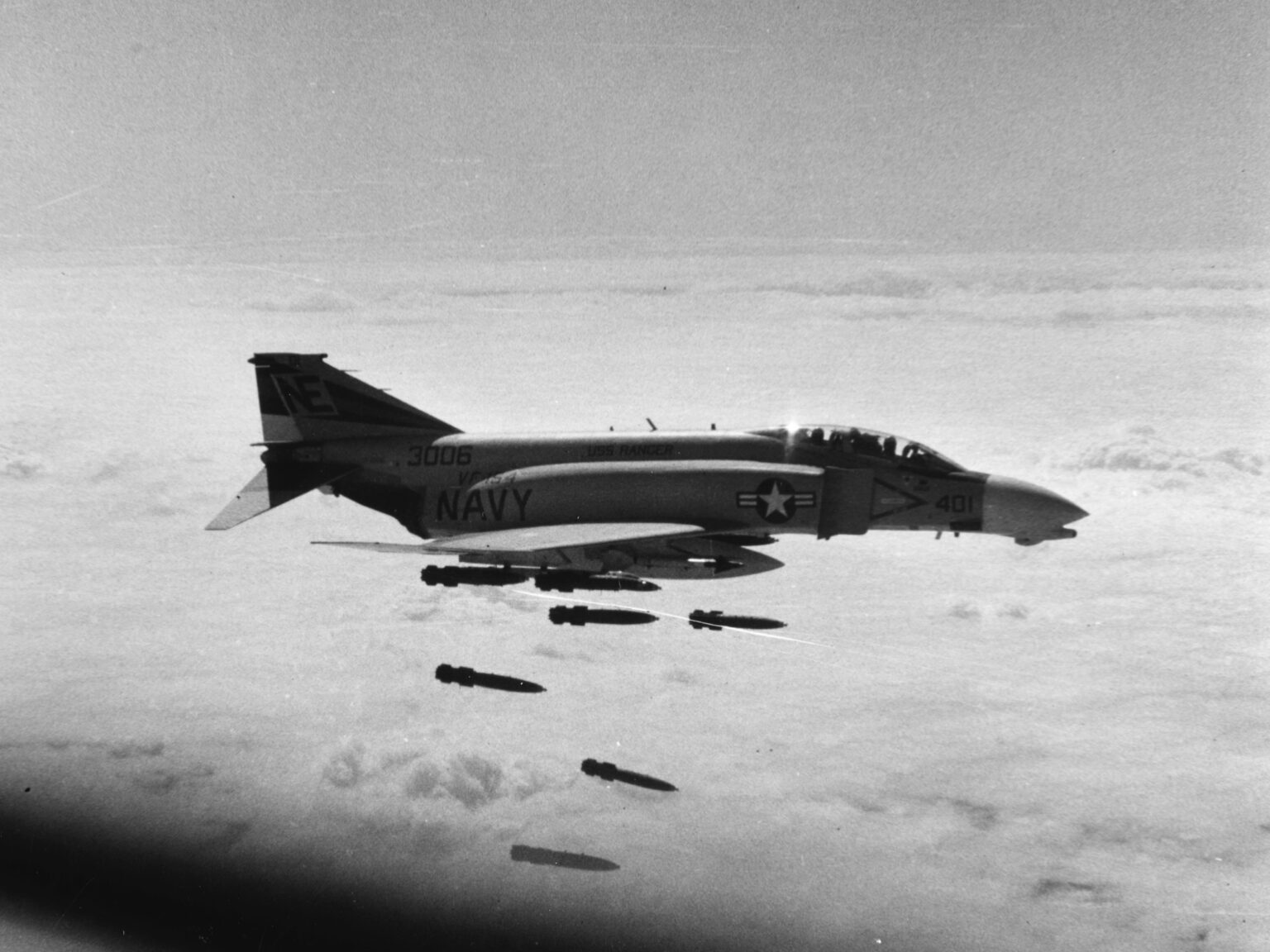

How superior training and tactical innovation transformed US Navy air combat performance in Vietnam
The F-4 Phantom II emerged as the US Navy’s primary fighter during Operation Rolling Thunder (1965-1968), evolving from an all-weather fleet interceptor to a multi-role platform performing ground attack, flak suppression, and combat air patrol missions. By the campaign’s end, Navy squadrons had achieved a 2-to-1 kill-to-loss ratio against North Vietnamese MiGs, though this masked deeper problems with missile reliability and air-to-air tactics.
The Challenge of Missile Warfare
The Phantom II’s sophisticated weapons systems initially disappointed in combat. The AIM-7 Sparrow, designed for long-range bomber interception, proved unreliable at close ranges where visual identification was required before firing. The AIM-9 Sidewinder often fell victim to sun glint and decoy flares, while both missiles suffered from inadequate maintenance and storage procedures aboard carriers.
By Rolling Thunder’s end, the AIM-7 achieved only an 8 percent success rate, and the AIM-9 managed just 15 percent, despite manufacturer claims of 50-90 percent effectiveness. A formal investigation led by Capt. Frank ‘Whip’ Ault revealed that quality control standards were insufficient and missile technicians were undertrained.
Tactical Disadvantages Against Soviet Fighters
The lightweight MiG-17 and MiG-21 possessed superior agility, particularly at low speeds and in turning engagements. North Vietnamese pilots operated from nearby bases with integrated ground control systems, allowing them to establish high-altitude ambush positions. Meanwhile, F-4 pilots—constrained by orders to escort strike formations and lacking adequate early warning—often found themselves at a disadvantage in close-quarters combat.
Lt. Cdr. Ronald ‘Mugs’ McKeown famously described fighting a MiG-17 with a Phantom II as “a knife-fight in a phone booth,” highlighting the disparity between the F-4’s design philosophy and combat reality.
The Have Doughnut and Have Drill Programs
A turning point came through classified testing of captured MiG aircraft at Groom Lake, Nevada. The USAF obtained a MiG-21F-13 from Israel and conducted comparative flights demonstrating American fighters’ advantages in speed and vertical maneuvers. Subsequent analysis of borrowed MiG-17s revealed their control limitations at certain speeds and their vulnerability to energy-management tactics.
Tests showed that a MiG-17 at 300 knots could execute a 6g, 360-degree turn without losing speed, whereas the Phantom II would descend to landing speed performing the same maneuver. However, the MiGs suffered from poor visibility, unreliable brakes, and limited endurance.
The Birth of Topgun
These findings catalyzed the establishment of the Naval Fighter Weapons School (Topgun) at NAS Miramar in 1969. Led by Lt Cdr Dan Pedersen and staffed by combat-experienced pilots, the program delivered rigorous air combat maneuvering training emphasizing teamwork, energy management, and the “loose deuce” two-ship formation.
The curriculum borrowed lessons from World War II and incorporated insights from pilots like Jim Laing and J. C. Smith, who had achieved MiG kills. Crews learned to maximize the F-4’s speed and rate of climb while minimizing dogfighting at low speeds where MiGs excelled. Critically, the AIM-9 Sidewinder was prioritized over the unreliable AIM-7, and pilots trained with live missile firing against drone targets.
Improved Aircraft and Weapons
The introduction of the F-4J variant from 1967 onward provided enhanced radar, improved bombing systems, and more powerful engines. Later missile variants—particularly the AIM-9G and AIM-9H Sidewinders—proved significantly more reliable than their predecessors.
The AIM-9H, the first solid-state Sidewinder, featured improved tracking and more powerful actuators, achieving a far more successful kill ratio than any previous AIM-9 model.
Linebacker Results
When aerial combat resumed during Operation Linebacker in 1972, the benefits of intensive training became apparent. The US Navy achieved a 6-to-1 kill-to-loss ratio (24 MiGs for four F-4s), compared to the USAF’s 2-to-1 ratio despite the Air Force’s advantages in radar-equipped variants. The disparity reflected the Navy’s systematic approach to tactical development and pilot education.
The transformation demonstrated that technological sophistication alone could not overcome deficiencies in training and tactical doctrine. Victory came through understanding an aircraft’s capabilities, learning from captured enemy equipment, and implementing disciplined, systematic instruction across an entire fighter community.
This article is from the book “US Navy F-4 Phantom II Units of the Vietnam War 1969-73” by Peter E. Davies, available here.
