


Early Development (1926–1939)
Secret negotiations between the Reichswehr and aircraft manufacturers Junkers and Dornier began as early as 1926, aimed at developing a long-range strategic bomber. To circumvent the Treaty of Versailles, the Ministry of Transport acted as the official negotiator. By 1927, the Army Ordnance Directorate had formalized technical requirements for a four-engined night bomber—codenamed “Gronabo”—specifying a minimum speed of 320 km/h at 5,000 meters.
By 1932, Dornier had already developed a four-engined bomber designated the Do P, but it failed to meet specifications. Shortly after, Dornier and Junkers were invited to submit new proposals: Dornier presented the Projekt P 33 (later the Do 19), while Junkers submitted plans for the Ju 89.
Progress was hampered from the outset by ideological resistance. Senior Luftwaffe figures—Udet, Milch, and Kesselring—dismissed the strategic bomber as an “unnecessary luxury,” preferring dive-bombers and twin-engined medium bombers such as the He 111, Do 215, and Ju 88. Their view held that future conflicts would be short and sharp, not the prolonged wars for which strategic bombers were designed.
One notable exception was Generalleutnant Walter Wever, the Luftwaffe’s first Chief of Air Staff, who strongly advocated for a heavy bomber fleet. His death in an aircraft crash in June 1936 effectively ended that internal debate.
Work on the Do 19 and Ju 89 prototypes was cancelled on 29th April 1937, officially due to insufficient engine power—a justification contradicted by the fact that German manufacturers were already producing engines exceeding 800 hp at that time.
The He 177: A Fateful Design (1937–1939)
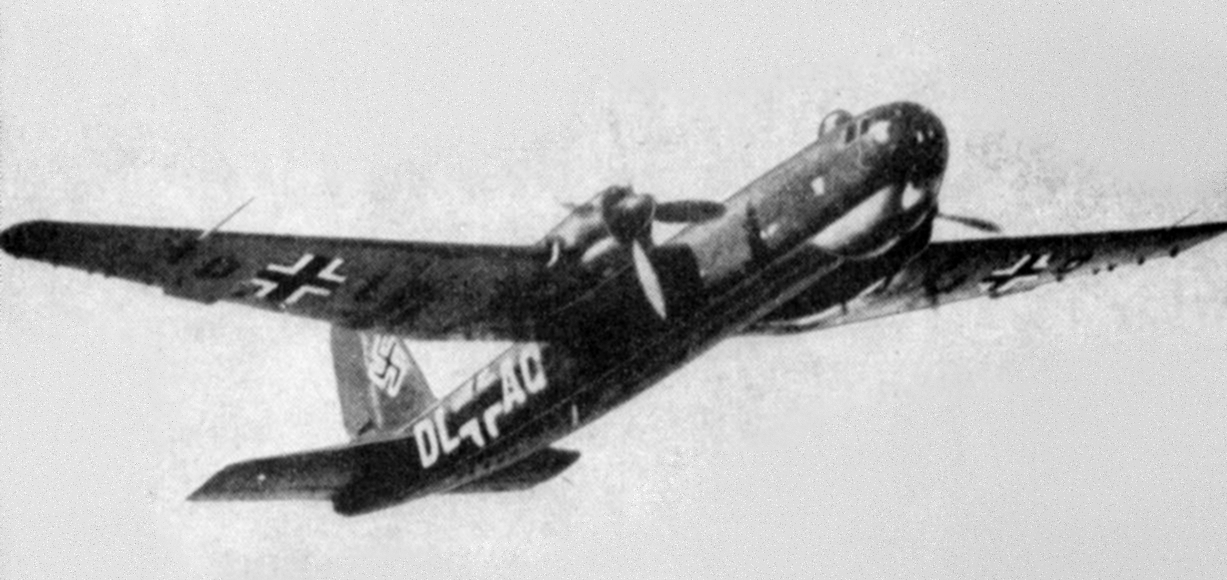
A revised requirement emerged calling for a bomber capable of carrying 1,200 kg over 2,500 km at a minimum speed of 500 km/h at 6,000 meters. Heinkel was awarded the development contract for their He P.1041 design, with the mock-up approved in August 1937 and the aircraft officially designated the He 177. Technical direction fell to Dipl.-Ing. Heinrich Hertel, with Dipl.-Ing. Siegfried Günther as project leader.
Due to the absence of sufficiently powerful single engines, two DB 601 units were coupled to drive a single propeller, forming the DB 606 twin power plant—successfully tested in the He 119. The He 177 made its maiden flight on 20th November 1939.
However, the aircraft’s surface evaporation cooling system caused severe structural distortion of the wing’s upper surface, halting test flights. Replacing it with conventional radiators increased weight and reduced range, requiring additional fuel that added yet more weight. The situation worsened when the Luftwaffe mandated full dive-bombing capability—a decision that forced major structural reinforcement and the addition of dive brakes, pushing the loaded weight to 31,000 kg. The He 177 never became a reliable operational aircraft, and its troubled service career cost hundreds of crew lives, the majority unrelated to enemy action.
The Jet Bomber Era (1943–1945)
By 1943, jet propulsion offered a realistic path to the speed, altitude, and range that piston engines had failed to deliver. Junkers developed a prototype four-jet bomber with forward-swept wings—the Ju 287—assembled largely from existing components: a He 177A-3 fuselage, Ju 188 tail surfaces, and undercarriage adapted from a captured B-24 Liberator. Four Jumo 004 jet turbines provided power, supplemented by Walter rocket packs for takeoff assistance.
The Ju 287 V1 flew for the first time on 16th August 1944. Test results at Rechlin were satisfactory, yet the RLM halted further development after only the second test flight—before reversing course at the start of 1945 and urgently demanding series production.
In November 1944, Messerschmitt submitted the Me P 1107, a four-jet flying-wing bomber designed to carry 4,000 kg at over 1,000 km/h over long distances. This was followed in January 1945 by the refined Me P 1108, with engines integrated into the wing roots and a V-tail replacing the original T-tail. Specified performance included a top speed of 1,020 km/h and a range of 7,400 km as a bomber, or 9,600 km in the reconnaissance role, at a take-off weight of 29,360 kg. Hitler, upon learning of the design, reportedly envisioned using it to attack New York and ordered all Messerschmitt resources directed toward it.
Junkers, meanwhile, developed the six-jet EF 130 and EF 131, while the Horten brothers submitted their Ho XVIII flying-wing project—powered by either two Jumo 018 turbojets or two piston engines—with a planned bomb load of 2 tonnes, a top speed of 850 km/h, and a range of 7,800 km.
Final Assessments (1945)
A DVL committee met on 26th January 1945 to evaluate competing proposals from Arado, Blohm & Voss, Horten, Focke-Wulf, and Messerschmitt. All designs featured high wing loading and required considerable further development.
A second and likely final industry-RLM conference took place in Dessau between 20th and 23rd February 1945, attended by Göring himself. DVL comparisons showed the Horten Ho XVIII superior in range and bomb load to the Junkers and Messerschmitt entries. The Hortens’ use of tubular steel, wood, and fabric also produced a significantly smaller radar cross-section than all-metal designs. Göring ordered immediate construction of the Ho XVIII.
Despite this directive, realistic prospects of completion were negligible. By mid-March 1945, both Messerschmitt and Junkers had been ordered by the RLM to abandon their long-range bomber work. On 23rd March 1945, Göring personally contracted the Horten brothers to proceed, though no tactical requirements had been formally defined and design work remained incomplete. Construction was to begin on 1st April 1945 at an underground facility in Kahla, Thuringia.
Engine supply proved a final obstacle: the intended Heinkel-Hirth 011 turbine was chronically delayed, the BMW 018 could not be obtained, and only a limited number of Jumo 004s remained available. The end of the war rendered all further efforts moot. Germany’s strategic heavy bomber program concluded without ever producing a fully operational type.
This article is from the book “Luftwaffe Secret Projects: Strategic Bombers, 1935-1945” by Dieter Herwig, available here.
