


How Cold War Tensions and Soviet Doctrine Shaped Egypt’s Failed Fighter Strategy
Political Victory, Military Challenge
Following the 1956 Suez War, Egyptian President Gamal Abdel Nasser emerged politically triumphant despite material losses. However, his government faced a critical problem: Israeli acquisition of advanced Dassault Mystère and Super Mystère fighters, plus expected deliveries of Mirage III interceptors, rendered Egypt’s MiG-15 and MiG-17 fleets obsolete. Iraq’s receipt of Soviet Tu-16 bombers further escalated regional tensions.
Soviet Modernization Blueprint
Recognizing these threats, Nasser dispatched Brigadier-General Abd el-Moneim Riyadh to Moscow in 1958 for advanced military training. Riyadh returned convinced that Egypt needed an integrated air defense system (IADS) modeled on Soviet doctrine—one combining radar networks, surface-to-air missiles (SAMs), fighter interceptors, and centralized command-and-control.
The Soviet approach had emerged from Cold War imperatives. After Korea and repeated US reconnaissance flights over Soviet territory, Moscow prioritized air defenses, sealing its airspace. The General Staff of the Soviet Armed Forces (GenStab) developed this strategy around high-altitude interception, deploying the S-75 SAM system (which successfully shot down a U-2 in 1960) alongside a new generation of fighters: the Su-7, Su-9, and MiG-21.
The June 1961 Arms Deal
Influenced by Riyadh’s demands, Nasser negotiated ambitiously with Moscow. Though Egypt faced debt from the Aswan High Dam construction and industrialization programs, the Politburo approved nearly all requests by June 1961: 48 MiG-21 interceptors, 30 SAM sites, 24 Tu-16 bombers, and 24 Antonov An-12 transports—totaling $170 million on favorable credit terms.
Operational Chaos
The timing proved disastrous. The Damascus coup in September 1961 fractured the short-lived United Arab Republic, forcing the air force to relocate personnel from Syria while absorbing new equipment. Experienced pilots were hastily sent to the USSR for six-week conversion courses at Sevastleyka, replacing the standard six-month program. Soviet crews ultimately flew the first Tu-16s and An-12s to Egypt, remaining to assist operations.
The MiG-21 Problem
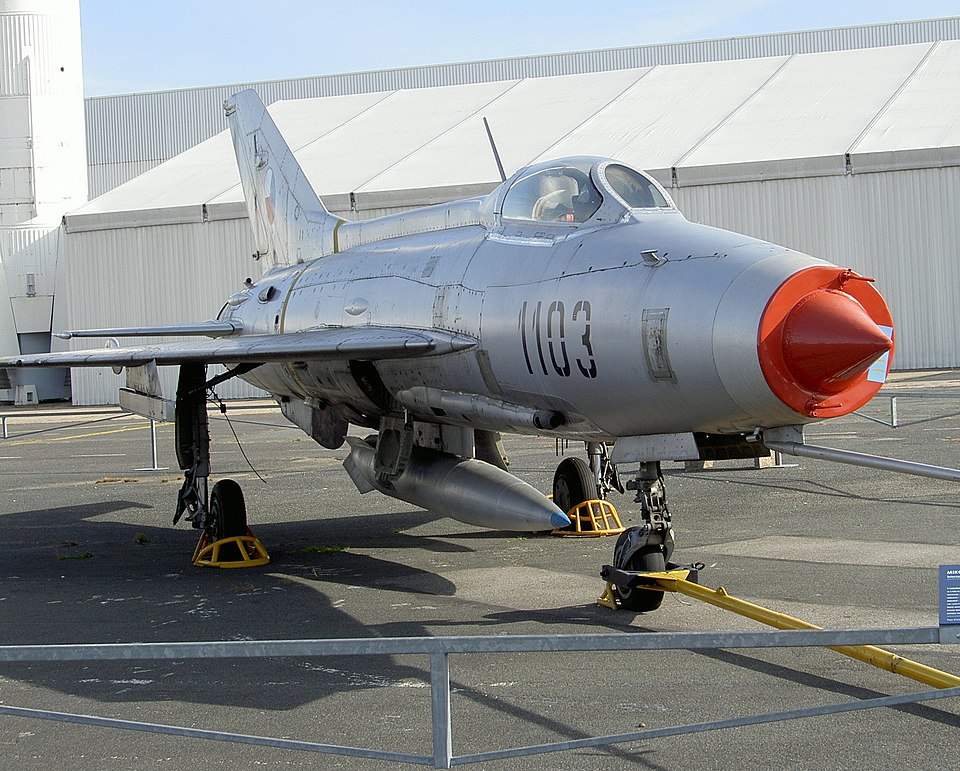
The MiG-21F-13 (Izdeliye-74) arrived in late 1961 and entered service with Nos. 40 and 47 Squadrons at Abu Suweir. Egyptian pilots found the aircraft “relatively easy to handle, a true joy to fly” at medium and high altitudes. However, fundamental design limitations plagued operations:
Fuel and Armament: Maximum endurance was merely 40 minutes with one drop tank. The sole 30mm cannon carried only 60 rounds. Two R-3S infrared missiles (copies of the AIM-9B Sidewinder) offered minimal capability: effective only above 550 meters altitude, requiring targets to maneuver below 2.3g, and with a maximum range of 1,500-3,500 meters.
Navigation: Minimal systems forced heavy dependence on ground control. Poor visibility through the armored windshield required pilots to search for targets through unarmored side canopy sections at ranges of 2,000-3,000 meters.
Structural Weakness: Manufacturing quality was poor. At speeds exceeding 945 km/h below 5,000 meters, fuel pumps failed, and control forces became excessive—risking structural failure despite the airframe’s 6g rating.
Soviet Doctrine vs. Egyptian Reality
The Soviet tactical manual for the MiG-21 emphasized high-altitude intercepts with minimal maneuvering—reflecting the type’s development for defending Soviet airspace against strategic bombers. It contained scant guidance for air combat against maneuvering targets and none for low-altitude operations. Egyptian commanders, similarly untrained in modern air warfare, amplified this limitation by prohibiting low-altitude flying during training.
Ground Support Gaps
Egypt’s radar network remained outdated. Soviet P-8 systems from 1956 couldn’t support supersonic operations. Requests for the advanced P-30 Khrustal radar went unfulfilled until approximately 1964—and even then, it couldn’t detect targets below 500 meters, contradicting Soviet doctrine recommendations for barrier combat air patrols at 1,500-2,000 meters or 7,000-8,500 meters altitude.
The Fundamental Mismatch
Egypt acquired a sophisticated interceptor optimized for scenarios—high-altitude interception near defended territory—that bore little resemblance to Middle Eastern air warfare. The aircraft lacked range for effective barrier patrols, carried insufficient armament for sustained combat, and relied on ground control systems Egypt couldn’t yet provide. Soviet training emphasized speed and altitude over the flexibility required for operations over hostile territory or in support of ground forces.
The result: a modern fighter that was technically advanced but operationally inadequate, highlighting the gap between doctrine transfer and battlefield necessity.
This article is from the book “MiGs in the Middle East: Volume 2 – Soviet-designed Combat Aircraft in Egypt and Syria 1963-1967” by David Nicolle and Tom Cooper, available here.
