

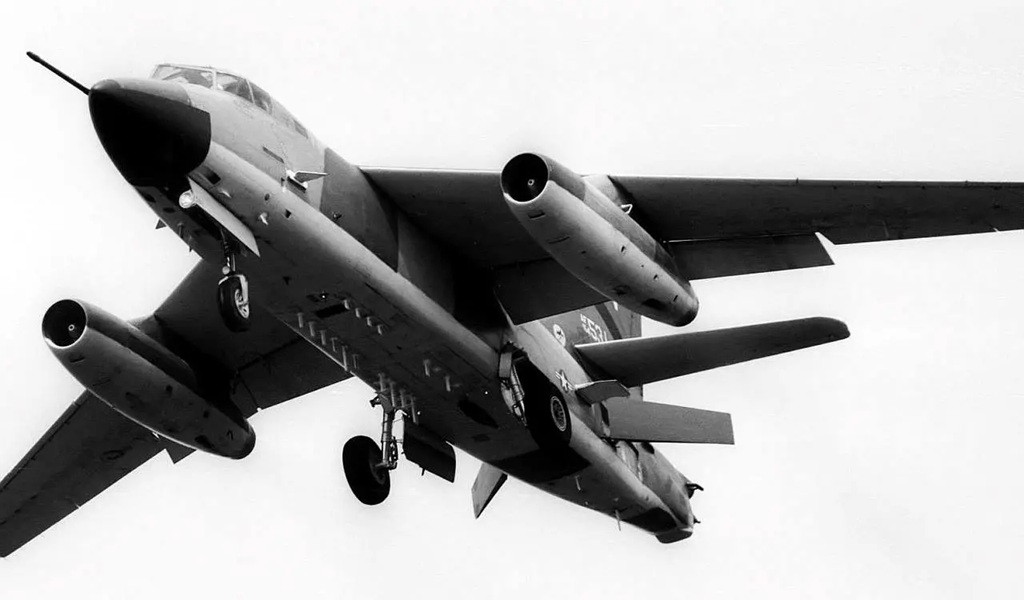

From Naval Origins to Electronic Warfare Backbone—The Unlikely Journey of the B-66
Between 1956 and 1974, the USAF operated 294 B-66 Destroyers—modest in number but outsized in strategic value. Produced in five versions and converted into eight variants, the aircraft originated from an unlikely source: the US Navy’s A3D Skywarrior, the largest carrier-based jet of its era and the first US Navy jet adopted by another service branch.
The Navy’s original specification called for a carrier-based nuclear striker with a 2,000-mile tactical radius carrying a 10,000-lb weapon. Douglas’s chief designer, Ed Heinemann—anticipating the cancellation of the intended supercarrier USS United States—scaled the design down to 68,000 lbs to fit existing Coral Sea-class carriers while building in growth potential that would eventually push maximum weight to 84,000 lbs. A contract for two XA3D-1 prototypes followed in March 1949.
Adapting the Skywarrior for the USAF
The USAF’s interest in a jet-powered light reconnaissance/bomber led to the RBL-X competition in June 1951. Several aircraft were evaluated—including the B-47, B-45, Martin XB-51, and even the Vickers Valiant—but the specification’s constraints (including a 6,000-ft takeoff distance) effectively pointed toward a modified Skywarrior. Douglas won the contract on 15 January 1952.
Adapting the A3D for land-based USAF use required significant changes: wing-folding and arresting gear were removed, upward-firing ejection seats replaced escape chutes, a larger radome accommodated the AN/APS-27 radar, and anti-icing equipment was added. The bomb bay was extended by 17.5 inches to carry larger nuclear weapons or up to 15,000 lbs of conventional ordnance. The modification process proved far more complex than anticipated, adding cost and delays.
Engine selection also complicated development. The preferred Pratt & Whitney J57 was unavailable due to priority allocation to the B-52 and Century Series fighters, so the Allison J71—rated at 10,000–10,200 lbs of thrust—was selected instead. The J71 suffered from reliability issues and compressor stalls in early service, and the absence of the J57’s eventual 15,000-lb thrust ceiling limited the B-66’s performance throughout its career. JATO bottles providing 12,000 lbs of additional thrust were available as a workaround for short-runway operations with heavy loads.
Production and Variants
Production was split between Douglas’s Long Beach, California, plant and a government facility in Tulsa, Oklahoma — a decision that added cost and management complexity. After five RB-66A reconnaissance prototypes, the RB-66B entered service in 1957. The B-66B bomber, ordered in April 1952 to replace the B-45A, used the B-47’s K-5 bombing system and AN/APS-23 radar.
The Tulsa facility produced 36 RB-66C electronic reconnaissance variants and 36 WB-66D weather reconnaissance aircraft. The WB-66D, based on the RB-66C and delivered in 1957, carried a five-man crew, including two observers in a bomb-bay capsule—though the aircraft never received its full scientific equipment suite and was primarily used for visual reconnaissance.
The RB-66C: Electronic Warfare Pioneer
The RB-66C was the heaviest, most expensive, and most capable of all B-66 variants. It was the first aircraft designed from the outset to survey hostile electronic environments and actively defeat threats with its own countermeasures—previously, Tactical Air Command had depended on Strategic Air Command for electronic intelligence.
Its pressurized bomb bay module housed four ELINT operators (known as “Ravens”) working AN/APR-9 and -14 receivers, AN/ALA-6 direction finders, AN/ALA-5 pulse analyzers, and a wire recorder. The central AN/APD-4 automatic receiver system—identifiable externally by fiberglass antenna pods under each wingtip—covered the 1,000–30,000 megacycles-per-second range. By 1967, wire recorders had been replaced by 14-track Leach audio and video recorders, and nine in-flight tunable jammers were carried.
In practice, the AN/APD-4 generated unmanageable data volumes and was eventually replaced by simpler analysis methods. By the late 1960s, the wingtip pods were empty, though retained for aerodynamic neutrality.
Vietnam and the EB-66
In 1966, the USAF redesignated its electronic aircraft, with “E” replacing “R” for electronic surveillance types—RB-66s, thus, became EB-66s. The EB-66B and EB-66C formed a complementary pair in Vietnam: the C-model detected and analyzed radar signals while the B-model jammed them.
General Joseph J. Nazzaro, Commander-in-Chief of Pacific Air Forces, acknowledged the scale of unpreparedness in December 1968: “Prior to the initiation of air operations over North Vietnam, the Tactical Air Forces were practically devoid of EW equipment and personnel. Crash efforts to develop, procure, and employ EW capabilities to meet Southeast Asian requirements were both late and costly.”
From December 1964, EB-66s received successive upgrades, including QRC-114 Green Dragon barrage jammers. Thirteen B-66Bs had earlier been converted into EB-66Bs from May 1959 under the Brown Cradle program to test active jamming within USAFE operations. From 1967, a further 52 RB-66Bs were converted by Dynalectron into EB-66Es, fitted with 21 jammers replacing cameras and an ECM tail cone in place of the gun installation.
The EB-66’s electronic warfare mission encompassed three functions: ECM (jamming enemy radar, including counter-jamming); ESM (collecting and analyzing enemy emissions to improve jamming); and ER/ELINT (all-source electronic data gathering). Though numerically limited, the type proved indispensable to strike operations over North Vietnam and remained in service well beyond its originally planned 1964 retirement date.
This article is from the book “B/EB-66 Destroyer units in combat” by Peter E. Davies, available here.
