

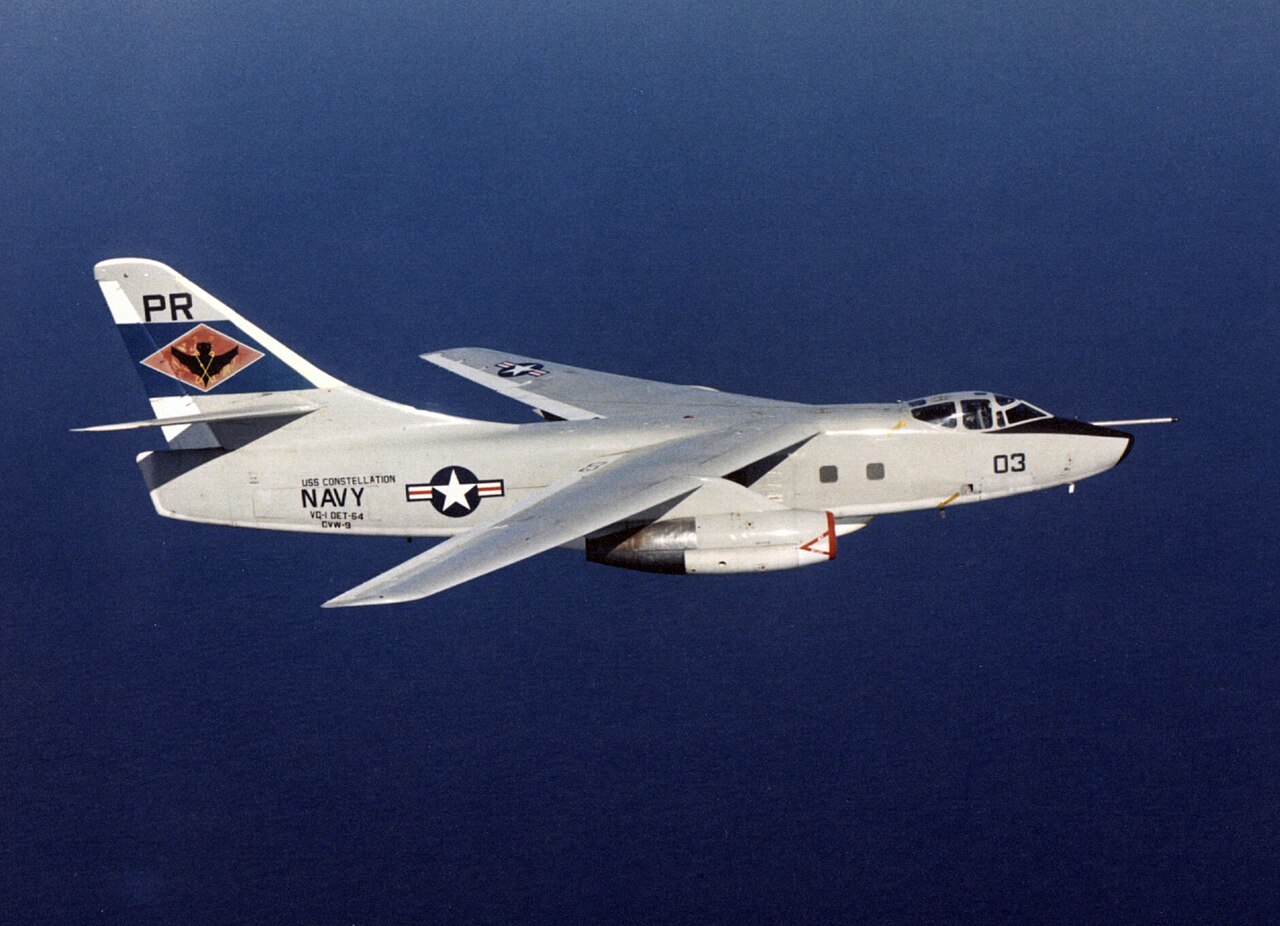

The “Whale” That Changed Naval Aviation Forever
Post-War Strategic Transformation
Following World War II, the US Navy recognized that maintaining relevance required developing its own atomic strike capability. Drawing lessons from the Halsey-Doolittle Raid of 1942, naval planners envisioned a twin-engined, carrier-based nuclear bomber operating from the new Midway-class carriers.
The arrival of atomic weapons in 1945 reinforced this direction but sparked fierce inter-service competition. The newly independent US Air Force championed land-based nuclear strikes via the enormous B-36 Peacemaker, arguing that carrier aviation was obsolete. This “turf war” sparked the “Revolt of the Admirals”—senior Navy officers who openly and covertly lobbied to preserve carrier aviation following the 1948 cancellation of the supercarrier USS United States (CVB-58).
Korea vindicated the Navy’s position. Starting with just seven fleet carriers in June 1950, the service expanded to 14 by July 1953, with the newly commissioned 60,000-ton USS Forrestal arriving in 1955 as the first true supercarrier.
Interim Solutions: Neptune and Savage
Initial attempts leveraged expedient measures. The Lockheed P2V Neptune—a land-based patrol bomber—was craned aboard carriers and launched via Jet Assisted Take-Off (JATO) bottles in April 1948. Unable to recover aboard ship, the aircraft landed on the beach. Though dramatic, this one-way capability proved unsustainable.
The North American AJ Savage followed (first flight, May 1949). This hybrid beast married piston engines with a buried jet engine, weighed 54,000 lbs at launch—more than twice any contemporary carrier aircraft—and offered a 700-nautical-mile combat radius. Yet the AJ earned a damaging reputation: its hydraulic systems leaked, canopy panels blew out, and flightdeck crews dubbed it a “pain in the arse.” Many were permanently stationed at bases in Japan and Morocco, standing nuclear alert rather than deploying with carrier airgroups. By 1955, composite squadrons flying the AJ were redesignated as Heavy Attack (VAH or “HATRON”), with East Coast units receiving odd hull numbers and Pacific squadrons even numbers.
The Skywarrior: Bold Design Meets Skepticism
In 1948, the Navy issued requirements for a jet-powered, carrier-based nuclear attack bomber capable of flying 2,000 miles at a combat radius while carrying a 10,000-lb bomb. Initial estimates suggested a 200,000-lb aircraft—far too large for existing carriers. Only Douglas and Curtiss-Wright submitted proposals.
Douglas assigned the task to Chief Engineer Ed Heinemann, the celebrated designer of the SBD Dauntless and AD Skyraider. Heinemann rejected industry assumptions, believing a compact design could operate from 45,000-ton Midway-class and even 29,000-ton Essex-class carriers. The atomic weapon’s physical size drove the entire design process, demanding a large bomb bay but enabling a smaller, lighter airframe.
Heinemann’s twin-engined jet, weighing just 34 tons fully loaded and armed with high-mounted swept wings, initially triggered Navy skepticism. Yet when the Pentagon cancelled the USS United States in April 1949, his compact design proved prophetic; Douglas remained in business.
First Flight and Engine Evolution
Designated A3D-1, the aircraft first flew on September 16, 1953, powered by Westinghouse J40 turbojets. The Navy-developed J40 suffered crippling problems across multiple aircraft programs and was cancelled. Douglas quickly substituted the USAF-backed Pratt & Whitney J57—a masterpiece powering the B-52, C-135, U-2, and numerous fighters. This choice proved critical to the Skywarrior’s success, with the J57 becoming one of aviation’s defining engines. Each J57-P-6 produced roughly 9,500 lbs of thrust.
After three years of intensive testing, the A3D-1 entered fleet service aboard modernized Forrestal, Midway, and Essex-class carriers equipped with angled flightdecks and steam catapults.
Inside the “Whale”
The three-man crew occupied a pressurized cockpit: the pilot (left side, yoke control), the bombardier/navigator, or B/N (right side, offset aft), and the plane captain (aft-facing, controlling the defensive twin 20 mm cannon turret).
The B/N position evolved from enlisted aircrewman to commissioned officer (Naval Air Observer) by the early 1960s, operating either ASB-1 or ASB-7 navigation/bombing radar paired with an optical bombsight featuring a nose-mounted periscope. Flightdeck crews marveled at B/Ns’ celestial navigation pride, with skilled officers routinely employing sextants for sun shots.
Access occurred via a belly hatch immediately behind the nose gear, with a second inner door sealing the cockpit pressure envelope and allowing depressurized access to the bomb bay for arming nuclear devices or emergency procedures.
Egress Nightmare
The Skywarrior notoriously lacked ejection seats. When designed in the late 1940s, no seats could save three men at low altitudes within weight constraints. The bailout required pulling a handle beside the pilot’s seat, pneumatically blowing the inner and outer doors to form a continuous slide from which crewmen sequentially jumped feet-first, with parachutes deploying automatically at 14,000 feet. The sliding overhead hatch remained a last-resort option due to tail-strike risk.
The pilot faced the hardest egress, requiring him to stand, rotate rightward while avoiding the center console, and exit—a maneuver nearly impossible at low altitudes. NATOPS recommended a minimum 8,000 feet altitude and no more than 250 knots, but actual conditions often demanded less and more. Many crews tragically had no option but to “ride the airplane in,” especially following failed catapult shots. Fleet requests to retrofit ejection seats were repeatedly denied; the A-3 retained its original egress throughout its operational life.
Performance and Design Refinement
The A3D proved reasonably maneuverable, capable of rolls and inverted flight in skilled hands, though aerobatic qualities were limited. Nuclear delivery employed a modified wing-over maneuver; bank angles were restricted to no more than 120 degrees, with loops and negative-G explicitly forbidden to prevent auxiliary drive failure and loss of hydraulics and electrical power.
Maximum speed reached 480 knots below 13,000 feet to a ceiling of approximately 40,000 feet. The empty A-3B weighed 43,000 lbs, with a maximum catapult launch weight of 73,000 lbs and arrested landing weight of 50,000 lbs. A remarkable June 1959 launch from USS Saratoga achieved 84,000 lbs gross weight, marking the heaviest aircraft ever catapulted from a carrier deck.
The Skywarrior remained the last fleet aircraft to use bridle catapult hookup (only the T-2C Buckeye training aircraft outlasted it in American service). A significant late-production modification introduced the Cambered Leading Edge Wing (CLE or “CLEO”), applied to just 67 aircraft beginning with the 178th airframe in December 1958. This feature reduced landing speeds by two to three knots.
Fleet Introduction: Crisis and Recovery
VAH-1 established at NAS Jacksonville on November 1, 1955, and VAH-3 (formed from VP-34 on June 15, 1956) became the first squadrons to receive the A3D-1. VAH-1 deployed aboard USS Forrestal in October 1956, followed by a Mediterranean deployment in January 1957. VAH-3 (the “Sea Dragons”) embarked nine aircraft aboard USS Franklin D. Roosevelt in July 1957.
Despite Navy publicity and Douglas’s promotional film “Jet Bombers at Sea,” early deployments exposed significant flaws. Both squadrons encountered maintenance nightmares, structural weaknesses, and catastrophic failures. Secondary power systems—hot bleed-air-feeding air turbine motors that powered electrical generators and hydraulic pumps—proved temperamental, with long piping susceptible to dangerous leaks that could ignite fires. Strengthened mountings, more powerful engines, and robust canopy frames became urgent retrofits. In 1957 alone, the first full operational year, seven major accidents occurred, including three spectacular carrier landing mishaps killing nine men, including senior officers in VAH-1 and VAH-2. Photographs of burning aircraft sliding down flightdecks with doomed crews aboard haunted the community.
VAH-1’s commanding officer, when asked if he’d ever launched all 12 aircraft simultaneously, sardonically replied: “Yeah, when they’re all up on jacks in the hangar bay.”
The Pilot Crisis
A more insidious problem emerged: pilot experience deficiency. Initial A3D crews came predominantly from the Patrol (VP) community—multi-engine operators with limited carrier experience. Senior officers frequently lacked adequate arrested landing experience. Commander, Sixth Fleet Vice Admiral Charles R. “Cat” Brown declared VAH units should be removed from carriers entirely, arguing that single-seat jets like the F2H Banshee and A4D Skyhawk could deliver improved, smaller nuclear weapons.
However, one VP-derived pilot, Lieutenant Ed Mitchell (VAH-2), later joined NASA in 1966 and became the sixth man to walk on the moon as an Apollo XIV member in February 1971.
The Navy responded decisively. New Wing Commodores—Captains James D. “Jig Dog” Ramage (Sanford) and William “Bush” Bringle (NAS Whidbey Island)—stressed professional carrier airmanship and rigorous training standards. Mid-grade, jet-experienced pilots were injected into the community (“kicking and screaming,” as frequently noted) to establish a core of boat-experienced operators.
Systemic improvements followed: the new RAG (Replacement Air Group) system, with VAH-3 transitioning to training after one deployment; the Fresnel Lens for carrier landings; and standardized NATOPS procedures—initially resisted by older pilots who viewed it as an affront to their abilities, with one high-time pilot lamenting, “NATOPS was written by men who were afraid to fly.” Yet NATOPS became “written in stone (and blood)” service-wide.
By late 1958, Vice Admiral Brown retracted his earlier position, stating plainly, “Eating crow isn’t hard when it tastes like filet mignon.”
Atlantic and Pacific Operations
The improved A3D-2 (“Dash Two”) featured J57-P-10 engines with 500 additional lbs thrust per side, increased G-loading (up to 3.4), bomb-bay fuel tank provisions, and system improvements. Heavy Attack Wing One (HATWING One) transitioned East Coast units (VAH-5, -7, -9, -11) to the A3D-2 at Sanford, Florida, consolidating all A-3 operations there by mid-1959—an innovative “type basing” concept that the Navy would soon adopt fleet-wide.
In the Pacific, Heavy Attack Wing Two operated from NAS North Island, California, initially overseeing AJ Savage units. VAH-2 (established November 1, 1955, from VP-29) received A3D-1s in April 1956, making the first Pacific deployment in July 1957 aboard USS Bon Homme Richard, followed by USS Ticonderoga. The Pacific Fleet lacked supercarriers in 1957, relying instead on modified Essex-class carriers (Bon Homme Richard, Ticonderoga, Lexington, Hancock, and the unique Oriskany)—vessels that would later earn legendary status in Vietnam.
VAH-2 moved to remote NAS Whidbey Island, Washington, in December 1957, becoming the nucleus of the Pacific A-3 community. Successive Pacific squadrons—VAH-4 (“Four-Runners,” established July 1, 1956), VAH-8 (“Fireballers,” May 1, 1957), VAH-6 (“Fleurs,” transferring January 1958), VAH-10 (“Vikings from the cold northwest,” May 1, 1961), and VAH-13 (“Bats,” October 1961)—converged at Whidbey. By January 1960, four deploying squadrons serviced all Pacific Fleet carriers. VAH-123, the west coast training squadron (“Professionals,” established June 29, 1959), transitioned aircrew and maintenance personnel.
End of the Deterrent Era
Production concluded at 283 aircraft in January 1961, with the peak fleet strength of 227 airframes achieved by mid-1961. Already, over 40 had been lost in accidents. May 1962 brought redesignation: A3D-1 became A-3A; A3D-2 became A-3B.
Throughout this period, the Skywarrior’s primary mission remained nuclear deterrence. Squadrons maintained one or two aircraft armed with special weapons, available for launch from protected hangar bays under Marine Corps guard. Tanking and conventional bombing were secondary.
Yet according to one experienced pilot: “The ‘special weapon’ delivery technique was to run in at very low altitude—down among the short-legged sheep—at 520 knots. When the B/N had the target on radar, he’d command a pull-up, which was done at 2.5Gs… The bomb bay doors opened, the bomb rake extended, the weapon released, and the doors closed. This all took place in about one second. You’d roll the aircraft 120 degrees, still at 2.5 Gs, and decrease the angle of bank to 90 degrees as the nose went through the horizon as you continued your turn in the opposite direction to avoid the blast.”
Vigilante Transition
The submarine-launched Polaris missile and the new North American A3J Vigilante—a “stone-cold beauty,” big, fast, and faster—terminated the Skywarrior’s deterrent mission. The Navy rapidly replaced A-3s at Sanford with A3Js beginning with VAH-3 in June 1961; VAH-1 followed in 1963. An A3D B/N at Sanford recalled, “At least the A3J gave you a chance to get home after delivering your weapon. We all figured the A3D was pretty much a one-way mission.”
The Vigilante evolved into the RA-5C photo-reconnaissance variant (RVAH squadrons), with conversion completed by the Vietnam War’s start. Only VAH-11 retained A-3Bs at Sanford before transitioning in 1966.
By 1965, Whidbey Island dominated the A-3 world, hosting four deploying squadrons (VAH-2, -4, -8, -10) and the training RAG. Four squadrons would carry Heavy Attack into Vietnam’s opening phases.
This article is from the book “A-3 Skywarrior Units of the Vietnam War” by Rick Morgan, available here.
