

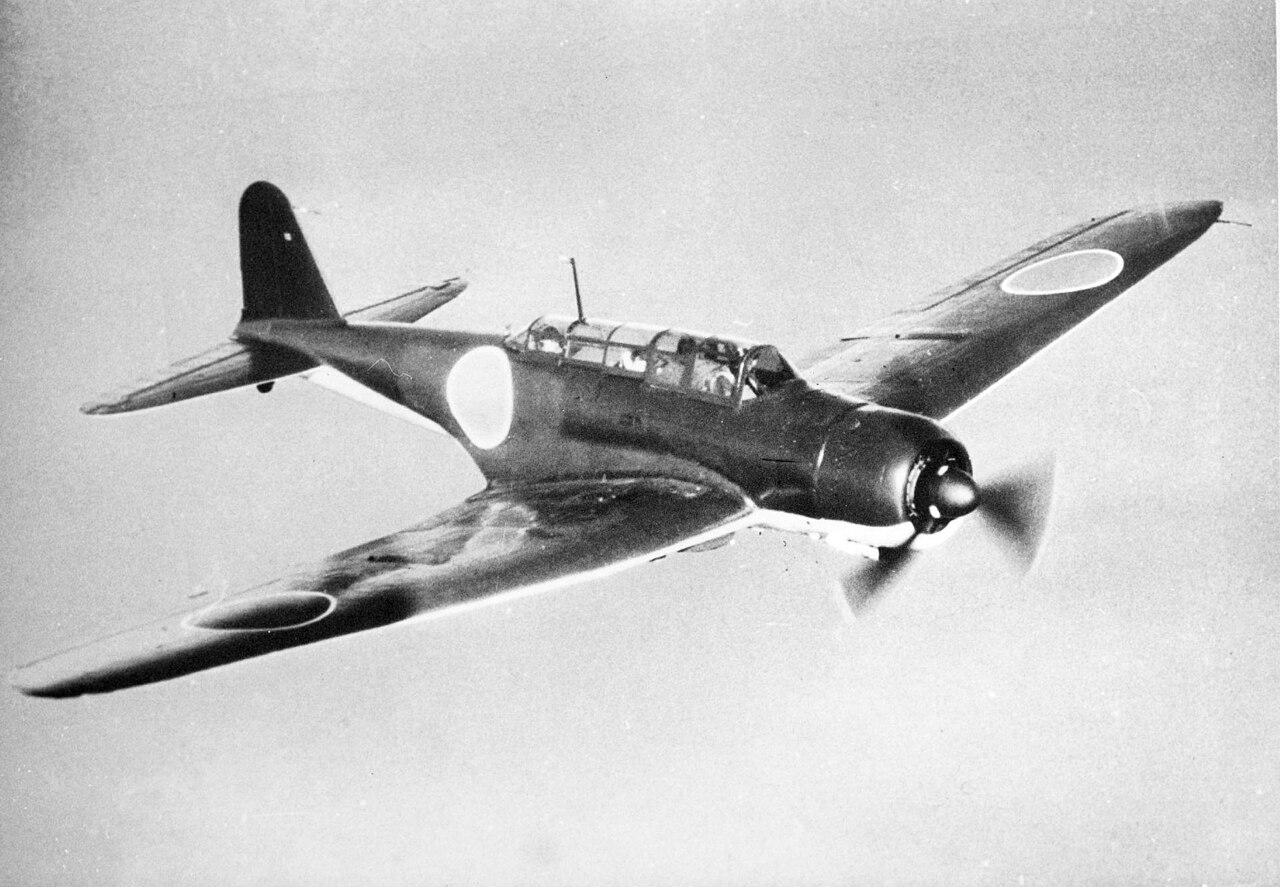

How Japan’s carrier bombers evolved from biplane to monoplane—and delivered the blow that brought America into World War II
The Last Biplane: Yokosuka B4Y1 “Jean”
In 1934, the Yokosuka Naval Air Arsenal answered the IJNAF’s 9Shi requirement with the B4Y1 “Jean,” the navy’s final carrier-based biplane bomber. Designed by Sanae Kawasaki, it featured an all-metal airframe, a fixed undercarriage, and was the first IJNAF carrier strike aircraft with an air-cooled radial engine. Crewed by a pilot, navigator, and radio operator/gunner, it first flew in late 1935.
Entering service in early 1937, the “Jean” saw its combat debut that December during the Panay Incident, helping sink the US gunboat USS Panay. It flew throughout the Second Sino-Japanese War from carriers including Akagi, Kaga, and Soryu, and even participated in damage-assessment flights during the Battle of Midway in 1942. From 1938, it was gradually replaced by the more advanced Nakajima B5N “Kate.”
Birth of the “Kate”
Issued in 1935, the IJN’s 10Shi specification called for a monoplane carrier attack aircraft to succeed the B4Y1. Nakajima’s design team, led by Katsuji Nakamura, produced an all-metal, low-wing monoplane with a retractable undercarriage—first flown in January 1937. It outperformed Mitsubishi’s rival B5M1 in trials, though Mitsubishi still built 125 B5M1s as backups, some seeing limited combat in Southeast Asia.
Designated the B5N1 (Type 97 Carrier Attack Aircraft), it initially used an underpowered engine while awaiting approval of the more powerful Sakae radial. Once cleared, Nakajima upgraded the design into the B5N2, which was faster and replaced the B5N1 from 1939. By war’s end, surviving “Kates” served in training, target-towing, and anti-submarine roles equipped with radar and magnetic detection gear. In total, 1,149 were built across three production lines between 1936 and 1943.
Combat Over China
B5N1s saw early action in 1938, bombing targets near Guangzhou and supporting Japanese army landings at Daya Bay. Mitsuo Fuchida, who later led the Pearl Harbor strike, flew dive-bombing missions during this campaign and recalled the operation went smoothly: “The Guangdong attack operation was easily and completed before I had a chance to flex my muscles as a leader.”
By 1940–41, B5N1s flying close-air-support missions for Japanese ground forces were replaced by the B5N2 as the IJN’s primary carrier strike aircraft.
Rethinking Carrier Warfare
Fuchida took command of Akagi’s air squadron in 1939, joining a navy that still viewed carriers as auxiliary, reconnaissance-focused assets deployed individually. Fuchida pushed back against this doctrine, arguing carriers should operate together for concentrated strikes. He found an ally in Rear Admiral Jisaburo Ozawa, who agreed that carrier airpower should be the decisive force in naval battles and championed combining four carriers into a unified strike group—a proposal Ozawa later submitted to naval leadership in 1940.
Practice exercises validated the approach. During a night torpedo drill in late 1940, Fuchida’s coordinated reconnaissance, flare-dropping, and torpedo squadrons achieved an 80 percent hit rate against four “enemy” battleships—a result that, in real combat, would have sunk them all.
Planning Pearl Harbor
By late 1941, the First Air Fleet’s six carriers (Akagi, Kaga, Soryu, Hiryu, Shokaku, and Zuikaku) carried 360 aircraft, split into two attack waves of 183 and 167 planes after accounting for aborts. Departing northern Japan on November 26, the fleet aimed for a position 230 miles north of Oahu, timing the strike for 30 minutes before sunrise.
Primary targets were the four US carriers believed to be in Hawaii (though Saratoga was confirmed elsewhere) and eight battleships at anchor. The attack force included 49 level-bombers under Fuchida, 40 torpedo-bombers under Lt. Cdr. Shigeharu Murata, and 78 dive-bombers under Lt. Cdr. Takashige Egusa.
The Attack Begins
“Kate” torpedo bombers carried specially modified Type 91 torpedoes with wooden fins to function in Pearl Harbor’s shallow water, while level bombers carried 800 kg armor-piercing bombs converted from naval gun shells.
Arriving over Oahu before dawn on December 7, Fuchida was stunned to find the entire Pacific Fleet at anchor. He gave the attack order at 7:49 AM and, four minutes later, signaled the famous “Tora-Tora-Tora,” confirming surprise had been achieved—a message relayed across Japanese forces throughout Asia and the Pacific.
Murata’s torpedo bombers struck first, hitting West Virginia at 7:57 AM. Other torpedo runs damaged Utah, Raleigh, Helena, and Oglala—Lt. Tsuyoshi Nagai’s group mistakenly targeted Helena instead of the drydocked Pennsylvania. Oklahoma was also struck and capsized.
Bombing Battleship Row
Fuchida’s level bombers approached via Barbers Point to avoid detection, splitting into groups targeting California, Nevada, Maryland, Tennessee, and Arizona. Anti-aircraft fire damaged Fuchida’s own aircraft, severing a control cable, though his pilot maintained control.
After a missed first pass, Fuchida’s group witnessed a massive explosion as bombs from Kaga’s squadron detonated Arizona’s forward magazine. Fuchida redirected his remaining four aircraft to Maryland, scoring two hits. Conflicting accounts exist over which squadron actually destroyed Arizona—Japanese records officially credited Hiryu’s group under Lt. Cdr. Tadashi Kusumi, whose bombs also struck the repair ship Vestal, though Kaga’s squadron had hit the battleship first.
The second wave, led by Lt. Cdr. Shigekazu Shimazaki, arrived around 8:40 AM with 78 dive-bombers under Egusa targeting ships obscured by smoke, plus level-bombers hitting Hickam Field, Ford Island, and Kaneohe. Fighter escorts under Lt Cdr Shigeru Itaya and Lt Saburo Shindo secured air superiority and strafed airfields.
Fuchida remained alone over Pearl Harbor for three hours afterward, coordinating the second wave and assessing damage.
Aftermath and Beyond
The attack killed over 2,000 sailors, 218 airmen, 109 Marines, and 68 civilians, sinking or beaching 18 warships, including five battleships. The US lost 169 aircraft destroyed and 159 damaged. However, the three US carriers escaped unharmed, and critical fuel depots survived—failures that would later prove costly for Japan. The IJNAF lost 29 aircraft, including five Kaga torpedo-bombers.
Within hours, IJNAF aircraft struck the Philippines, with “Kates” and A5M “Claude” fighters from the carrier Ryujo attacking Davao. Through December, Ryujo’s aircraft supported invasions of Luzon and Mindanao.
Later that month, B5N2s from Hiryu and Soryu supported the invasion of Wake Island, suffering losses to Marine F4F Wildcats before the atoll fell. In January 1942, “Kates” bombed Rabaul, Lae, Salamaua, Madang, and Ambon ahead of Japanese landings in New Guinea and the Dutch East Indies—though Fuchida later described these missions as overkill.
By February, “Kates” from Ryujo were targeting Allied shipping fleeing Singapore. Capt. Oliver Gordon of HMS Exeter recalled the intensity of these raids: “The sea would be alive with great soaring sheets of water” as bombs fell near maneuvering ships. Despite difficulties hitting fast-moving targets, Ryujo’s aircraft did sink the grounded Dutch destroyer Van Ghent in February.
This article is from the book “Nakajima B5N ‘Kate’ and B6N ‘Jill’ units” by Mark Chambers with Tony Holmes, available here.
