

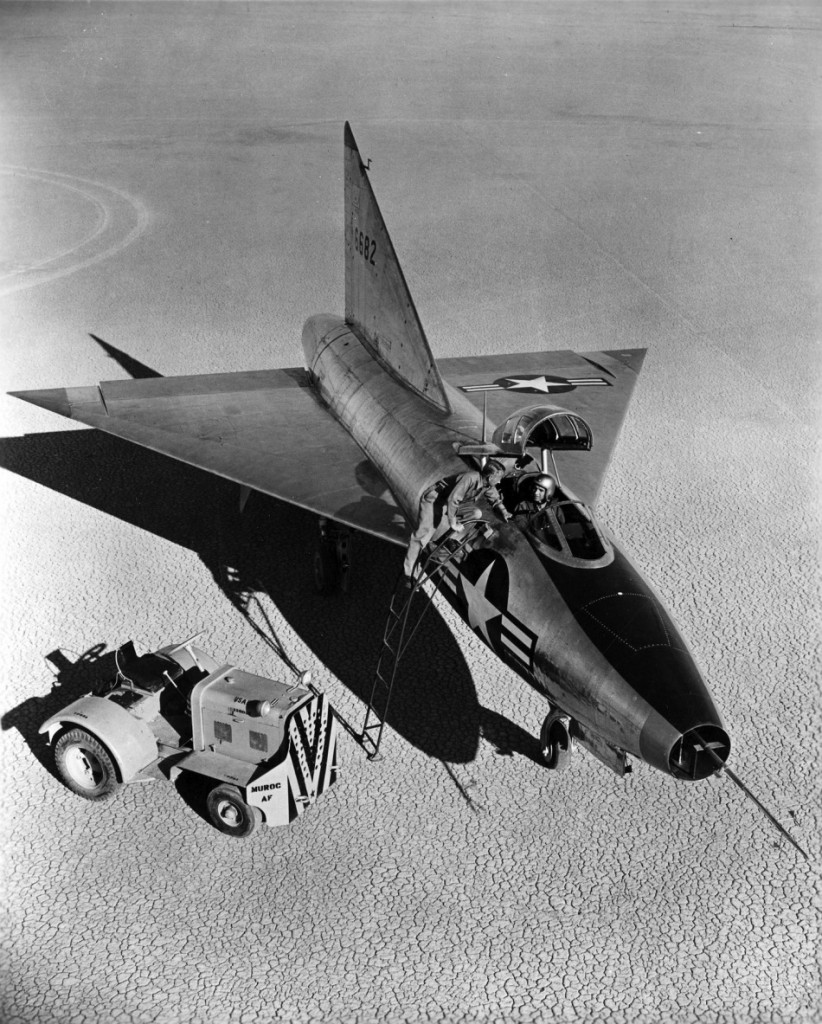

The Experimental Jet That Proved the Delta Wing — Despite Itself
Certain structural features became design signatures for aircraft manufacturers — the Hawker and de Havilland vertical tails of the 1930s, Northrop’s flying wings of the 1940s, Boeing’s podded engines of the 1950s. For Convair, the delta wing defined its post-war identity so completely that the company considered patenting the concept. It underpinned interceptors that served USAF and Air National Guard units for over three decades, a prototype supersonic seaplane fighter for the US Navy (the YF2Y-1), and the world’s first supersonic bomber, the B-58 Hustler.
In the early 1940s, NACA aerodynamicist Robert T. Jones had already proposed a thin delta wing for high-speed flight, though doubts lingered over its low-speed behaviour and tendency to generate high roll rates under high lift. The answer arrived in 1945 with the capture of the German Lippisch DM-1 — a wooden glider representing the first pure delta-wing aircraft — along with its designer, Dr. Alexander Lippisch, who was brought to the United States under Operation Paperclip. NACA’s subsequent 1946 wind-tunnel tests of the DM-1 at Langley Field, with Lippisch assisting informally, revealed significant problems with the thick-wing design, but the research was shared with Convair, which had won a USAAF contract in June 1946 to develop a supersonic point-defence interceptor designated MX-813.
Early designs used a 35-degree swept wing, but wind-tunnel testing exposed poor low-speed performance. Chief of Design Adolph Burstein settled on a 60-degree delta, drawing on Lippisch’s data and NACA’s findings. Lippisch was formally seconded to Convair in October 1946, further convincing chief aerodynamicist Ralph Schick that a tailless delta was the right path — provided it was thin, unlike the German originals.
The XF-92A: Proving the Concept
The delta wing offered clear advantages for supersonic flight: low transonic drag, gradual lift reduction at high angles of attack with no abrupt stall, no need for trailing-edge flaps or a horizontal stabiliser, and a deep wing root providing structural strength, generous fuel capacity, and resistance to the aileron-reversal problem that plagued swept-wing fighters. Former F-102A pilot Col. Shaun Ryan, who also flew the F-100 Super Sabre, described how the latter’s thin 45-degree swept wing required rudder — not ailerons — to correct a dropped wing on landing approach: “If you used ailerons the aircraft would go opposite to the control input… In a high-G turn, if you used ailerons to steepen the bank angle, the plane could snap roll in the opposite direction.” No such problem afflicted the delta.
When the USAF cancelled the XP-92 interceptor in June 1948 over concerns about its rocket-ramjet propulsion, an earlier proposal for a simpler “flying mock-up” was revived as the XF-92A — intended solely to validate the delta wing. Using off-the-shelf hardware, a conventional turbojet, and a 60-degree delta wing, the aircraft incorporated an important innovation: combined aileron-elevator surfaces called elevons, operated by fully hydraulic, irreversible flight controls — a first for any aircraft.
Convair chief test pilot Ellis “Sam” Shannon flew the XF-92A for the first time on 18 September 1948 at Muroc. The controls proved extremely sensitive — light inputs on the column could deflect a single elevon by a fraction of a degree, inducing roll instead of pitch. Shannon admitted the system “left much to be desired” and made the aircraft “very difficult to fly straight and level.” Crosswinds above 25 mph also grounded it repeatedly. Despite these issues, USAF Phase II testing under Maj. Chuck Yeager yielded more promising results. Yeager reached Mach 1.05 on his second flight and landed the jet at just 67 mph, the aircraft still flying at a 44-degree angle of attack. He was enthusiastic about the delta’s stall and spin resistance, though he acknowledged it was a “tricky” aeroplane.
Maj. Frank Everest noted stability concerns, particularly a pitch-up tendency in high-speed turns, but confirmed that supersonic transition was smoother than with other wing types. A later engine upgrade with an afterburner proved problematic — the unit flamed out routinely above 38,000 ft and required six engine changes in 19 months.
NACA assumed control in February 1953, and test pilot Scott Crossfield flew 25 additional sorties, bringing the total to 119 flights. Crossfield was blunt in his assessment, calling the XF-92A “the worst-flying airplane built in modern times that I know of — a hopeless mess, a patchwork quilt of fixes upon fixes.” He noted persistent issues with power, weight, brakes, and control sensitivity. Yet he conceded that the aircraft had generated enough data to make the F-102 viable, and that its handling had ultimately proven far better than many aerodynamicists had feared. The jet ended its career on 14 October 1953 when a nose-gear strut collapsed during taxiing. Rather than fund a $50,000 repair, the USAF retired the aircraft; it is now preserved at the National Museum of the US Air Force at Wright-Patterson AFB, Ohio.
The XF-92A’s 62 flying hours over five years persuaded Air Materiel Command to proceed with the F-102 Delta Dagger, which equipped USAF interceptor squadrons for over 15 years. Its research also contributed to the Douglas A-4 Skyhawk and F4D Skyray. The aircraft even appeared in two 1950s Hollywood films — Jet Pilot (with John Wayne, though the footage was cut) and Toward the Unknown, starring William Holden.
This article is from the book “F-102 Delta Dagger Units” by Peter E. Davies, available here.
